
March 4, 2026

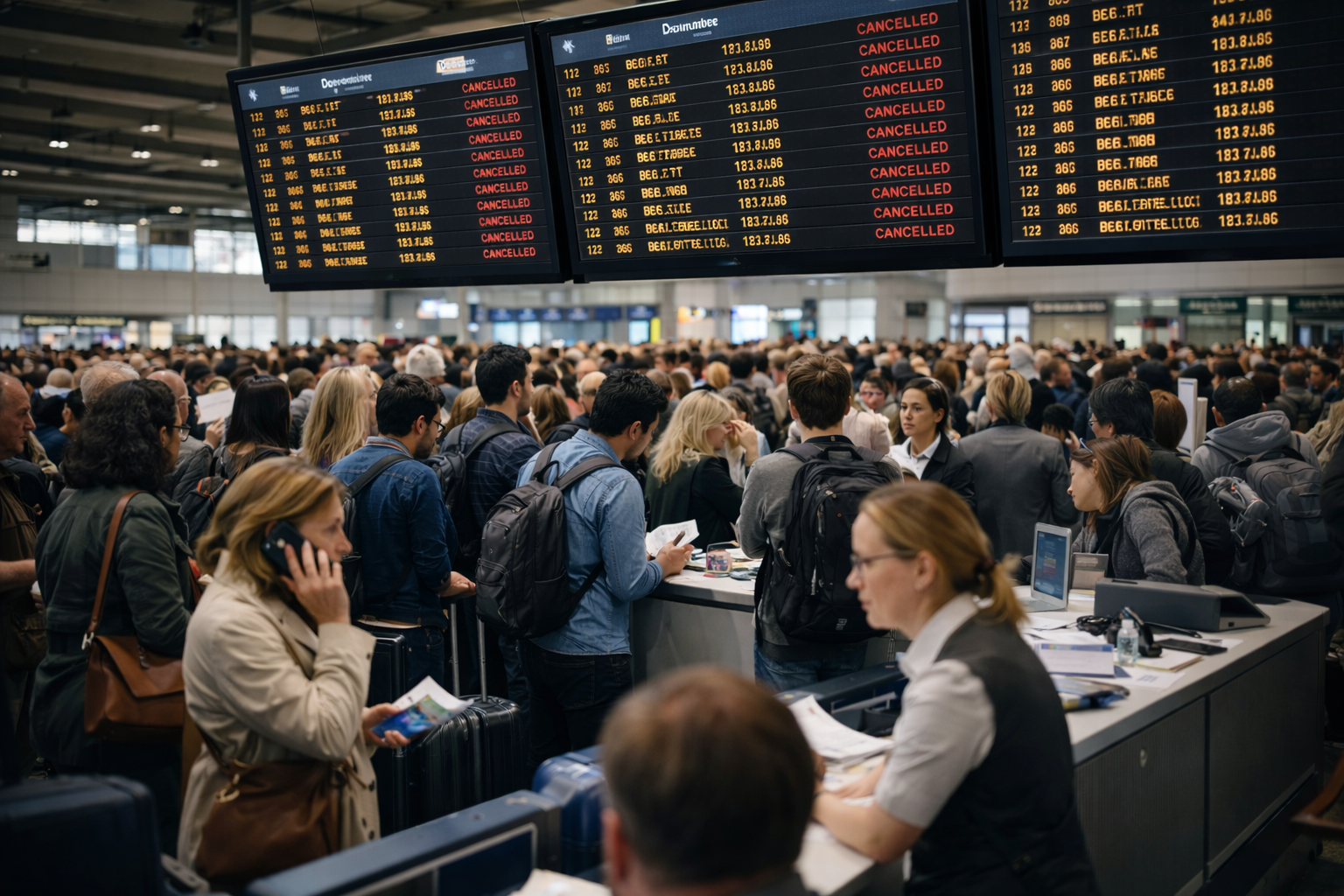
Over the past few days, global aviation has experienced significant disruption following escalating tensions and airspace closures across parts of the Middle East.
Flights have been cancelled, aircrafts have been rerouted mid-journey, and thousands of travellers around the world have suddenly been left trying to figure out what happens next.
According to international aviation reports and global news coverage:
Major international hubs such as Dubai, Doha and Abu Dhabi normally among the busiest transit airports in the world were forced to restrict or suspend flights, leaving tens of thousands of travellers stranded globally.
Airlines also had to divert aircraft mid-flight, with some planes turning around after flying for hours because airspace suddenly became unsafe.
This is not just a regional issue.
The Middle East acts as the central corridor connecting Europe, Asia, Africa and Australia, meaning disruptions there quickly ripple across the global aviation network.
Flights travelling between cities like London, Singapore, Bangkok, the Maldives, India or Australia frequently pass through this region.
When airspace suddenly closes, airlines must redesign entire routes.
Aircrafts may need to fly longer paths around restricted areas, sometimes adding one to three hours of additional flying time.
Which is why a traveller flying from London to the Maldives or Thailand may experience disruption even though their destination is nowhere near the conflict.
These changes quickly create knock on delays and cancellations across the global aviation network.
When large-scale travel disruptions occur, airlines do not simply cancel flights and leave passengers to figure things out themselves.
Behind the scenes, airlines immediately issue operational bulletins to the global travel trade including their direct partners such as travel agencies and ticketing professionals responsible for managing bookings on behalf of travellers.
Over the past few days, airlines have issued multiple disruption notices that included instructions such as:
For example, some airlines authorised travel agencies to:
Each airline publishes its own waiver codes, ticketing instructions and deadlines.
These notices are highly technical and often several pages long.
Most travellers never see them.
But for travel professionals, they are the key to resolving disrupted travel plans quickly.
For travellers who booked flights independently online, the experience during disruptions can look very different.
When flights are cancelled or rerouted, airports and airline call centres quickly become overwhelmed.
Passengers often find themselves:
Airline staff are doing their best to assist, but during major disruptions they may be helping dozens of passengers at once.
It is not unusual to see queues of fifty or more travellers all waiting to speak with an airline representative after a cancelled flight.
For travellers already exhausted from long journeys, the situation can become extremely stressful.
If I’m being completely honest, flights are the most stressful part of travel to manage.
Accommodation issues can be frustrating, but at least you are already at your destination and there is usually time to resolve things.
Flights are different.
When flights go wrong, travellers may be stuck in transit, exhausted after long journeys, or simply trying to get home.
And when all you want to do is reach your destination or return home, the last thing anyone wants is to stand in a queue at an airport desk with fifty other passengers trying to solve the exact same problem.
From a travel design perspective, flights are often the most complex part of any itinerary.
They involve:
Managing these situations quickly requires experience and access to the right systems.
For clients travelling with Soft Life Travel, the process works very differently.
Instead of navigating the situation alone, we are already working behind the scenes.
Because we operate within the airline trade ecosystem, we receive disruption notices and airline waiver policies directly.
This allows us to begin reviewing solutions immediately.
Over the past few days, that has meant:
While some travellers may still be standing in line at airport desks trying to understand what options are available, Soft Life Travel clients already have someone actively working within the system on their behalf.
In many cases, by the time travellers are still waiting for assistance, our clients already have clear guidance or updated travel plans.
Modern travel is influenced by far more than simply choosing a destination.
Flights can be affected by:
Events happening thousands of miles away can affect routes and schedules across the entire aviation network.
Which is why working with an experienced travel designer can make a meaningful difference.
At Soft Life Travel, our role goes far beyond booking flights or hotels.
We provide:
Luxury travel is not just about where you stay.
It is also about how smoothly your journey is managed when circumstances change.
The past few days have been a powerful reminder of how interconnected global travel truly is.
Airspace closures thousands of miles away can disrupt journeys across continents.
For travellers, the goal remains simple: enjoy the journey.
At Soft Life Travel, our role is to ensure that journey continues as seamlessly as possible even when the unexpected happens.